How Three-Way Matching Works and Why It Matters for AP Automation
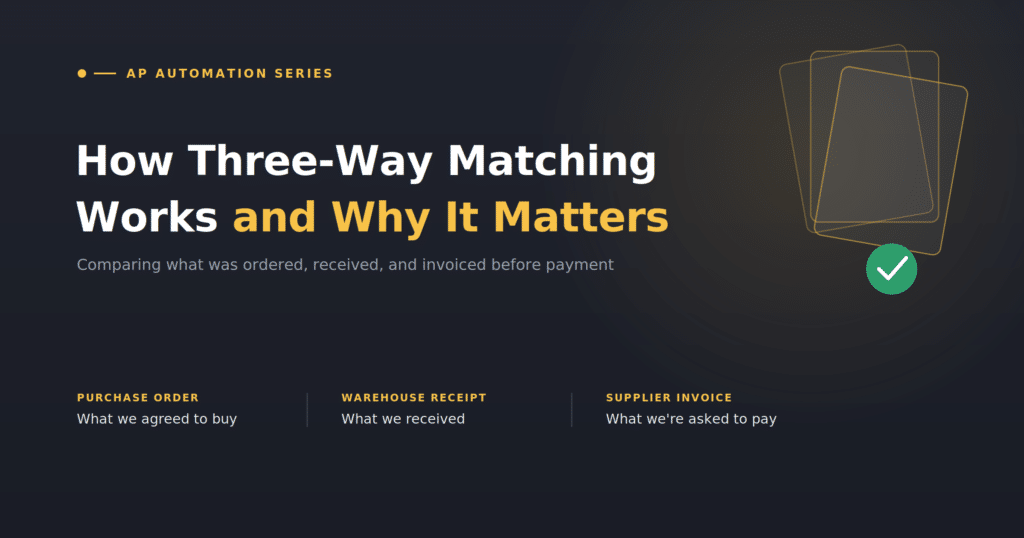
- How Three-Way Matching Works and Why It Matters for AP Automation
- The three-way match
- Why a PO Alone Is Not Enough
- The Real Operational Complexity: Partial Receipts, Multiple Deliveries, and UOMs
- How GoldFinch Supports PO-Related Invoice Review
- Three-Way Matching Is Not Just About Catching Errors
- Three-Way Matching Depends on Good Operational Data
- Three-Way Matching Creates Trust Before Payment
Before You Process a PO Invoice, You Need to Know What Happened
A purchase invoice arrives for 1,000 cases of material. It lists the supplier, a PO number, a quantity, a price, and a total. It may look straightforward. But AP still needs answers to three questions:
- What did the company authorize?
- What did the company actually receive?
- What is the supplier asking the company to pay?
For a PO-related invoice, those answers come from three records: the Purchase Order, the warehouse receipt, and the purchase invoice. Comparing them is called three-way matching.
Three-way matching is an important AP control for organizations that purchase, receive, store, manufacture, or distribute physical goods. It is primarily for PO-related invoices; valid non-PO invoices normally follow a different approval and review process.
What Is Three-Way Matching?
Three-way matching compares three views of the same purchasing transaction:
- Purchase Order: What did we agree to buy?
- Warehouse receipt: What did we actually receive?
- Purchase invoice: What is the vendor asking us to pay?
The objective is not necessarily to prove that every field is identical. It is to identify whether the records agree closely enough for the invoice to move forward—or whether there is a discrepancy that needs review.
For example, a PO for 1,000 cases at $20 per case, a warehouse receipt for 1,000 cases, and a purchase invoice for 1,000 cases at $20 per case present a clean match. The purchase invoice agrees with what was ordered and received.
The three-way match
Three records, one question: does everything agree before we pay?
Purchase order
What did we agree to buy?
1,000 cases @ $20
Warehouse receipt
What did we actually receive?
1,000 cases received
Purchase invoice
What is the vendor asking to be paid?
1,000 cases @ $20
Clean match
Why a PO Alone Is Not Enough
A Purchase Order shows what the company intended to buy. It does not prove that goods arrived.
Suppose the PO is for 1,000 cases, but the warehouse has recorded receipt of only 800. If the purchase invoices all 1,000 cases, AP has a discrepancy to investigate.
That does not automatically mean the purchase invoice is wrong. The remaining 200 cases may be in transit, receiving may not have entered the final receipt, the PO may have changed, or the supplier may need to correct the invoice. Three-way matching makes the difference visible before the invoice is treated as though everything agrees.
The Real Operational Complexity: Partial Receipts, Multiple Deliveries, and UOMs
Three-way matching becomes difficult when AP must reconstruct purchasing history manually.
One PO may be received in several deliveries. One purchase invoice may cover several receipts. Several invoices may be issued against one PO. A supplier may invoice in cases while inventory is managed by the each, pound, pallet, or another Unit of Measure.
Those conditions do not mean matching has failed. They are exactly why matching needs a clear ERP record, timely receiving, and defined processes for resolving differences.
Without that structure, AP can spend hours switching among PDFs, POs, receipt records, email threads, and spreadsheets just to understand what happened.
How GoldFinch Supports PO-Related Invoice Review
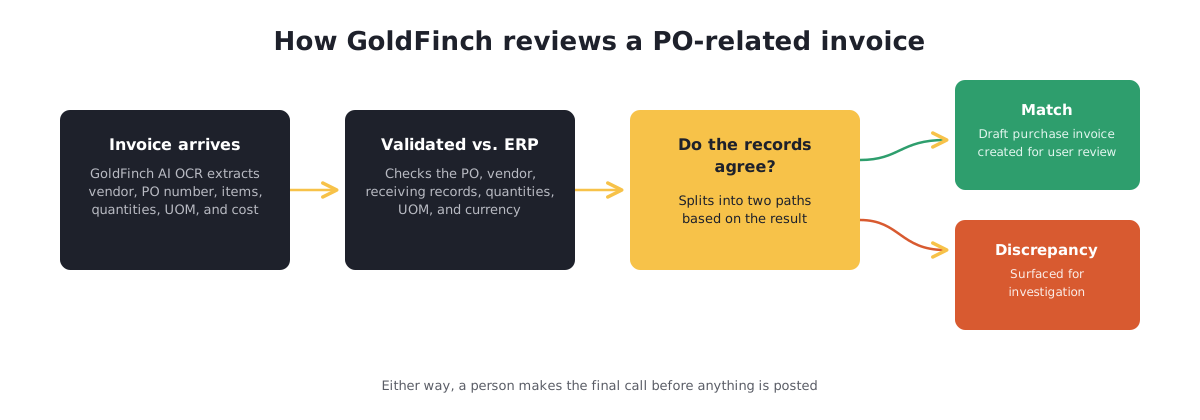
GoldFinch AI OCR can extract relevant purchase-invoice information, including vendor, PO number, items, quantities, Units of Measure, costs, and other line details. GoldFinch can then validate applicable, available invoice information against relevant ERP records.
For PO-related invoices, that may include locating the Purchase Order, confirming the vendor relationship, checking receiving information, evaluating invoiced quantities against recorded receipt quantities, comparing item and UOM information, and checking currency or other configured transaction information.
When the available information supports the transaction, GoldFinch creates a draft Purchase Invoice for user review. When it does not, GoldFinch can surface the discrepancy for investigation.
The goal is not to automatically post every matched invoice. GoldFinch creates a draft Purchase Invoice so users retain control over review and posting.
Three-Way Matching Is Not Just About Catching Errors
Three-way matching can help organizations identify invoices submitted before goods are received, find receiving transactions that have not been entered, detect quantity or UOM differences, clarify PO changes before payment, reduce avoidable vendor disputes, and improve coordination among AP, purchasing, and warehouse teams.
It also gives AP a clearer answer when a vendor asks why an invoice has not been paid. The issue may be a missing receipt, a quantity difference, a PO change, or another condition requiring resolution.
Three-Way Matching Depends on Good Operational Data
AP automation cannot compensate for missing or unreliable ERP data. For matching to work well, organizations need current Purchase Orders, prompt warehouse receipts, consistent item and UOM setup, and clear ownership for vendor, price, quantity, and receiving issues.
For a detailed exception-ownership framework, see What Happens When AI Gets an Invoice Wrong? Managing AP Exceptions Without Losing Control.
Three-Way Matching Creates Trust Before Payment
The purchase invoice tells you what the vendor wants to be paid. The Purchase Order tells you what the organization agreed to buy. The warehouse receipt tells you what actually arrived.
When those records agree, AP can move forward with greater confidence. When they do not, the discrepancy deserves attention before it becomes an accounting or payment problem.
Related Reading:
Why Invoice Extraction Isn’t Enough
What Happens When AI Gets an Invoice Wrong?
Vendor Payment Automation Is Not the Same as AP Automation
See how GoldFinch can validate PO-related invoices against purchasing and receiving records before they are posted.