Blogs

Three colleagues reviewing printed plans together at a conference table, with a warehouse and loading docks visible through the window

The Rare Combination: Salesforce, Accounting and Industry Under One Roof

Why the team behind your ERP matters as much as the software Over the first three posts in this series, we made three arguments. The platform beneath an ERP decides how well it ages. The processes and data structures inside it should come from industry experience. And trustworthy numbers depend on a disciplined separation of

The Rare Combination: Salesforce, Accounting and Industry Under One Roof Read More »

How GoldFinch Earns Trust in ERP Implementation: Facts, Feelings, Needs, Next Steps

More than a go-live An ERP decision is a bet-the-business decision. When a manufacturer, distributor, or food bank chooses GoldFinch, they hand us their inventory, their orders, their books, and the daily routines of everyone who touches them. If we get it wrong, trucks don’t ship, and invoices don’t go out. So our job doesn’t

How GoldFinch Earns Trust in ERP Implementation: Facts, Feelings, Needs, Next Steps Read More »

Is Salesforce-Native Accounting Right for Your Organization?

Over the first three parts of this series, we covered the cost of disconnected Salesforce and accounting systems, what changes when accounting operates on the same platform as customer and operational data, and how that connection improves decision-making across a service organization. This final article is meant to be practical: a checklist for evaluating whether

Is Salesforce-Native Accounting Right for Your Organization? Read More »

How Connected Accounting Improves Business Decision-Making

Part 1 of this series looked at the cost of disconnected Salesforce and accounting systems. Part 2 explained what changes when accounting operates on the same platform as customer and operational data. This article addresses the question finance leadership actually cares about: what does that connection change about how the business makes decisions? Cleaner data

How Connected Accounting Improves Business Decision-Making Read More »

What Changes When Accounting Operates on the Salesforce Platform

In Part 1, we looked at what disconnected Salesforce and accounting systems cost service businesses: duplicate data entry, inconsistent records, delayed reporting, and hours spent reconciling spreadsheets instead of reviewing results. The common thread was architectural. Two systems, built separately, asked to describe the same business.  So, what actually changes when accounting isn’t a separate

What Changes When Accounting Operates on the Salesforce Platform Read More »

The Hidden Cost of Disconnected Salesforce and Accounting Systems

If you run finance for a Salesforce-based professional services firm (consulting, legal, architecture, engineering, or similar), you’ve probably lived some version of this: a deal closes in Salesforce, and then someone on your team re-creates it in a separate accounting system. A client updates their billing contact. Now it’s correct in one place and outdated

The Hidden Cost of Disconnected Salesforce and Accounting Systems Read More »

Why ERP Projects Fail After Software Selection

Selecting an ERP system is a major decision. It is not the decision that determines success. Success is determined by what the organization does next. After months of requirements gathering, demonstrations, reference calls, pricing discussions, and contract negotiations, selecting an ERP platform feels like a major finish line. The executive team has approved the investment.

Why ERP Projects Fail After Software Selection Read More »

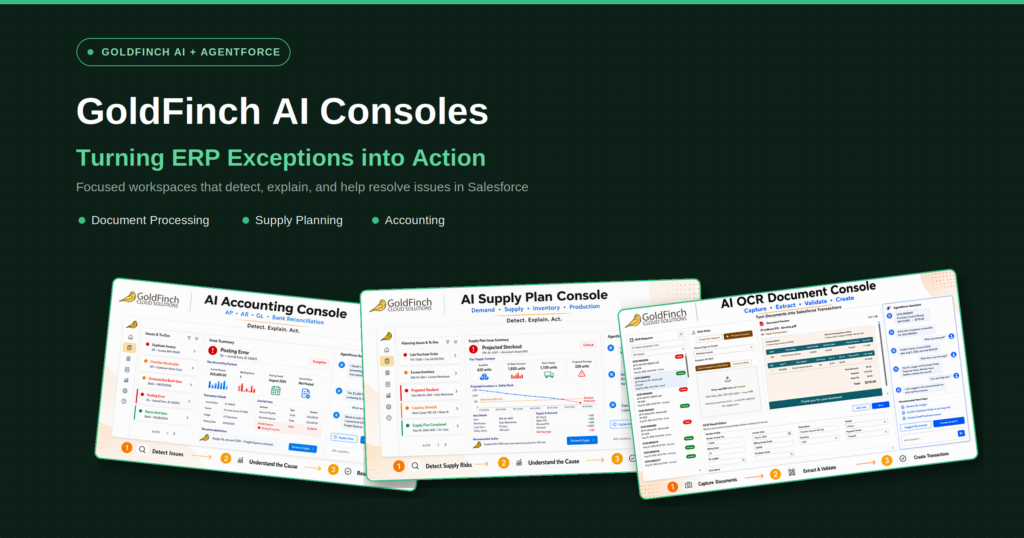
GoldFinch AI Consoles: Turning ERP Exceptions into Action 

ERP systems hold enormous amounts of operational and financial data. The real challenge is not finding more data – it is knowing what needs attention, why it matters, and what to do next.  GoldFinch is developing a new generation of AI-powered operational consoles to help users move from exceptions to action. These consoles will identify issues, bring the relevant information

GoldFinch AI Consoles: Turning ERP Exceptions into Action  Read More »

10 Configure-to-Order Manufacturing Challenges and How to Connect the Process

One Customer Promise Crosses the Entire Company A configure-to-order manufacturer makes a deceptively simple promise: build the product the way the customer needs it and deliver it when promised. The difficulty appears after the customer selects dimensions, features, materials, or performance options. Those selections affect price, engineering, material availability, production steps, cost, delivery, and later

10 Configure-to-Order Manufacturing Challenges and How to Connect the Process Read More »

From Supplier Invoice to Vendor Payment: How the AP Lifecycle Works

AP Automation Does Not End When the Invoice Is Posted  A posted Purchase Invoice records an important fact: the organization owes a vendor money. But it does not complete the AP cycle.  The invoice still needs to be paid. Once paid, the payment needs to be recorded against the original Purchase Invoice so AP aging, vendor balances, and financial

From Supplier Invoice to Vendor Payment: How the AP Lifecycle Works Read More »

Vendor Payment Automation Is Not the Same as AP Automation

Already Using BILL or Ramp? Start Earlier in the Workflow.  BILL and Ramp can be strong payment partners. They can help organizations execute vendor payments through the methods and workflows supported by their platforms.  But payment is only one part of Accounts Payable.  For manufacturers, distributors, food banks, and nonprofit meal programs, an earlier question

Vendor Payment Automation Is Not the Same as AP Automation Read More »

Scroll to Top